message
Content Warning: This article contains brief descriptions of disturbing violence against women and children.
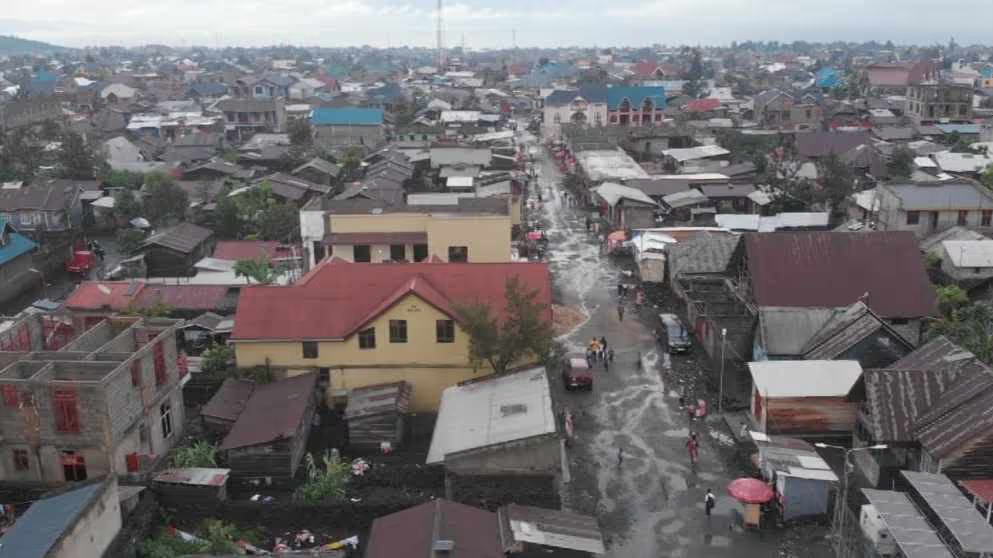
Although western media doesn’t pay much attention, cross-border conflict driven by international desire for eastern Congo’s rich mineral deposits, used in cell phones and other electronics, has left millions dead or homeless. Goma, Stany and Mariam’s home city, has been a flashpoint for violence for many years. Located close to the Rwandan border, it sits near coltan, gold, cobalt, and rare earths mines.
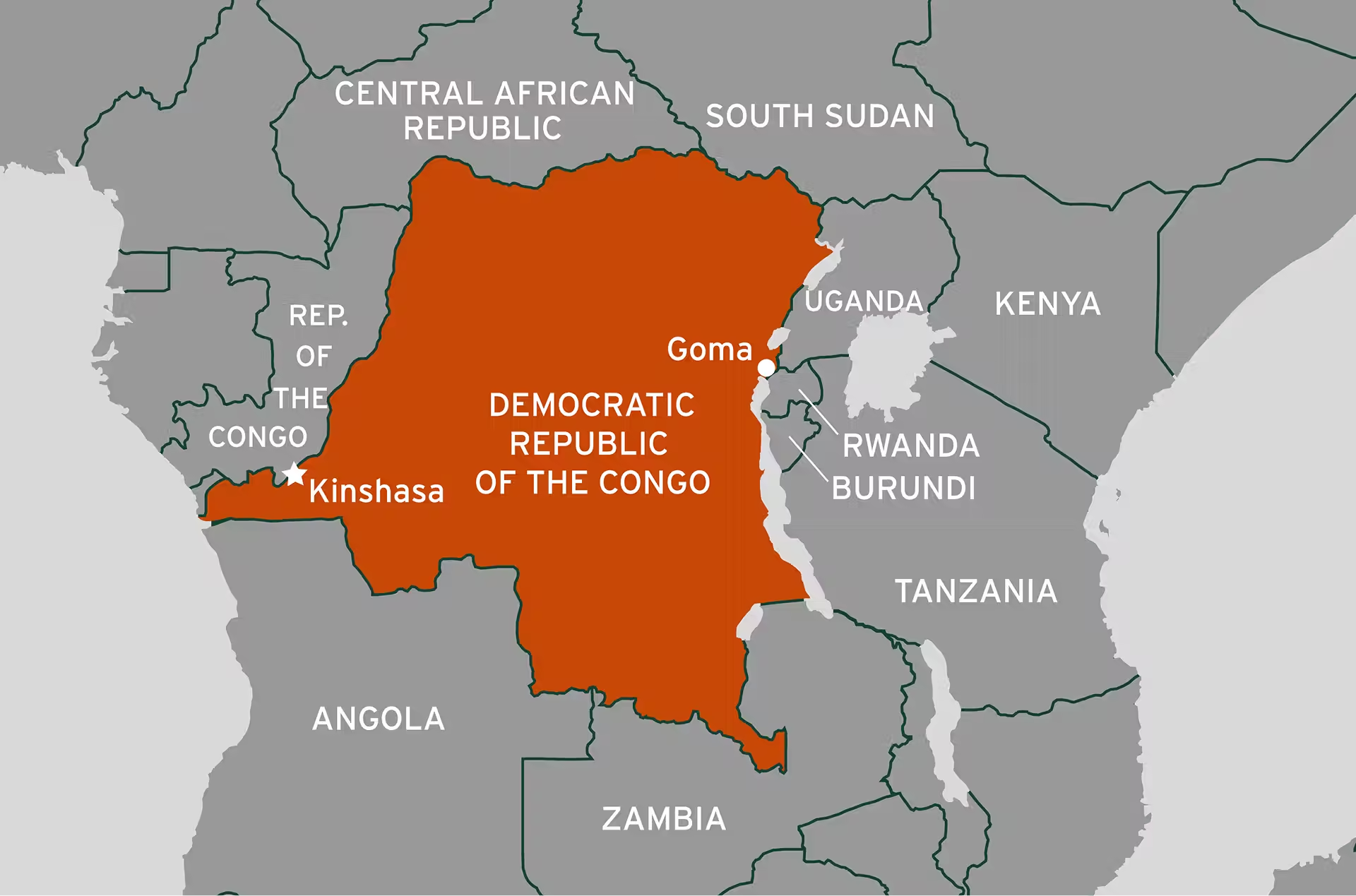
The conflict, sometimes called The Great War of Africa, is complex and involves tribal conflict as well as fighting between nations. Two major conflicts, the First Congo War (1996-1997), precipitated by the Rwandan genocide, and the Second Congo War (1998-2003), killed millions (The International Rescue Committee estimates 5.4 million excess deaths 1998-2007).
Although peace was officially signed in 2003, the Second Congo War never really ended, with intermittent violence particularly in the eastern region around Lake Kivu, where Goma is the largest city. A variety of rebel groups, the armed forces of Rwanda, and the Congolese military are all active, attracted by the mining wealth in the region. (For more background, we recommend a recent video by YouTuber Johnny Harris, The World’s Most-Ignored War, that explains the relationship between the governments and the rebel groups.)
Rape is routinely used as a weapon to intimidate and demoralize. Girls as young as 6 and women as old as 70 experience sexual violence, mutilation as well as rape. The rape is a systematic strategy to drive families away from valuable mining areas through fear and shame. In August 2025, Amnesty International summarized the situation thus: “For the women of eastern DRC, nowhere is safe; they are raped in their homes, in the fields, or camps where they seek shelter….Women and girls…continue to bear the greatest brunt of this conflict.”
The number of women victimized is hard to pinpoint because of fear of reporting sexual violence and because of the chaotic situation. The American Journal of Public Health estimated nearly 2 million victims by 2011, and rape has continued to be widespread since then. In addition to trauma and fear, victims often suffer from long-term physical issues. Women are forcibly impregnated, and when this occurs, they are often deserted by their husbands, left homeless and without means to provide for themselves.
Goma has endured periods of violence interspersed with peace, but Centre Medicale Maman Clementine became more directly impacted, and more needed, in 2024-2025.
In 2024, M23 rebels ramped up attacks around Goma, occupying villages, raping and killing the inhabitants. Goma, which already had a population of 2 million, became flooded with refugees desperate for food and shelter. Overcrowded refugee camps sprang up around the city, disease spreading swiftly. (M23 is a militia who claim to be defending the rights of Congolese ethnic Tutsis from government discrimination. The Congolese government avers that they are funded and supplied by the Rwandan government, motivated by desire for minerals.)
In January 2025, M23 rebels captured Goma itself, cutting off food and water for a time and setting up a parallel governmental structure. Eventually water was restored, but the unrest meant that farming was unable to go forward, leaving the city hungry and overcrowded. Women who were pregnant, often because of sexual assault, people with injuries and illnesses including malaria and cholera, and children orphaned by fighting all came to CMMC, seeking food and medical care. Stany’s personal connections in Goma meant that donations from outside the region were successfully transferred to CMMC, and they were able to purchase medicine and food to help many, although the need remained far greater.
Even after a U.S.-brokered peace deal signed between Congo and Rwanda in June 2025, with an additional signing personally hosted by U.S. President Trump in December 2025, M23, which was not directly involved in the peace process, remains in control of Goma.
Support expanding care in Goma
Your donation will go directly to supporting care for orphans, mothers, and all who need care in Goma, Democratic Republic of the Congo.